
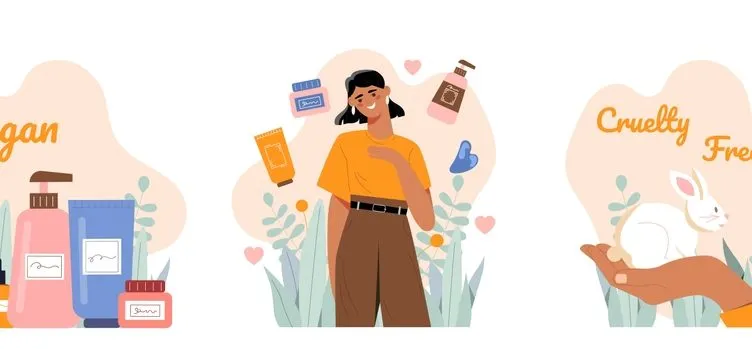
You do care about where your beauty products come from. You want to pick cruelty-free. However many labels fail to provide enough information, making it difficult to verify their claims.
And this lack of clarity is the fundamental concern. “Cruelty-free” sounds so simple, yet the reality often fails to align with the marketing. Knowing what really makes cruelty-free beauty items genuine, can help you avoid paying for a label, instead of the actual standard.
Not all cruelty free beauty products provide the same value. The term appears on packaging across every price point, and in every aisle, but what it actually means is the sourcing decisions, the testing history, the supply chain choices made long before a formula ever sees a shelf varies a lot from brand to brand. Knowing what to check for is the line between buying into a marketing checkbox, and buying into something like a genuine standard.
Why Cruelty Free Beauty Products Are Rarity Today
Saying a product is cruelty free should mean one clear thing: no animal testing, at any point, on any ingredient or the finished blend.
A statement on a box is pretty simple. Building a real process around it, step by step through every ingredient, is not. That is exactly why true cruelty free beauty options feel harder to find than the labels want you to believe.
The fine print, Most cruelty free labels skip
What many people don’t notice is this: “cruelty free” and “vegan” are not the same label.
- A product can be cruelty-free and still include animal sourced parts, like beeswax or lanolin.
- A product can be vegan, and still have seen animal testing somewhere along the supply chain.
- Those claims ask different questions. A label that answers only one does not automatically mean it is concealing anything, but it is smart to check which one you are actually buying into.
There’s also a geography problem. Some countries have, historically, required animal testing for cosmetics sold within their borders, even if the actual product development happened elsewhere. A brand that’s serious about cruelty free claims has to make deliberate decisions about where it sells and how it does that, not only about what is in the formula.
This part is what separates a genuine standard from a marketing checkbox: it influences choices the customer never really sees, long before a product ever hits a shelf.
It’s also why a single ingredient list rarely says the whole story. Two products can list almost the same components and still end up with entirely different testing histories. One gets shaped by policy in a market that still allows animal testing, and the other gets shaped by a deliberate choice to avoid that market.
That distinction is why we ask those questions clearly at Yuni, rather than assuming a formula automatically counts as cruelty free by default.
Why sourcing matters as much as the Ingredients
Every formula begins with a sourcing choice. The best brands treat that choice as seriously as what ends up in the finished product
That typically means:
- Choosing organic, sustainable, fair-trade options when they’re available
- Partnering with growers who use eco-conscious cultivation methods
It’s the difference between a formula that manages to sidestep animal testing and one that is built around avoiding it from the beginning, on purpose.
From Farms to Formulas: How Yuni Beauty Sources Ingredients
This approach often stretches back even farther than a product line. One of Yuni’s founders, Emmanuel Rey, spent years before the brand existed, working hands-on with cocoa and coffee growers in West Africa, showing techniques that supported better crop quality and stronger grower livelihoods
And, that standard doesn’t shift by category. It shows up just as much in post workout recovery products made to ease the aching muscles after a class or a long run, as it does in a facial serum meant for daily use.
Manufacturing That Holds Up the Ethics on the Label
Ethical sourcing means little if the rest of the process does not stay on the same line. It’s part of why our manufacturing runs on solar power , which you rarely hear mentioned in a beauty routine conversation but it shows how deep a real commitment goes.
If something is being placed among the best skin recovery products for an active routine, then the sourcing behind it deserves the same attention.
Packaging With a Plan, Not Just a Claim
Sustainability claims are simple to publish, and much harder to confirm. Yuni Beauty’s Shower Sheets are a useful example here, made with LENZING™ Viscose sourced from certified sustainable forestry :
- Independently verified by Organic Waste Systems to decompose in both soil and marine settings
- Different from standard wipes, which can take as much as a hundred years to decompose
- Supported by a packaging partnership with Pact Collective, focusing on materials that can be technically recyclable but very seldom actually get recycled due to their size or mixed composition
That same rigor spills over into what happens after a product is used, not only what goes into it. And it stays steady, no matter the format, the standard doesn’t loosen just because it’s sized for a gym bag or a carry-on.
Travel size skincare products get the same scrutiny as anything resting on a bathroom shelf at home, which matters more than it sounds when these smaller formats are where corners get trimmed first, too often.
A Global Standard, Not a Regional Exception
Values are easiest to keep at a small scale. They get more difficult to hold once a brand is on shelves at Sephora, Nordstrom, Anthropologie, and Credo Beauty, which is where you’ll find Yuni today, reaching customers across more than five countries.
Growing the business didn’t mean loosening the standard here, if anything, it showed that the standard could actually scale.
For a health-conscious, always-moving woman trying to figure out what goes into her routine, the consistency is the real point. The same sourcing, the same ethics, no matter where she is standing that day.
And it holds true when she’s putting together a proper home routine, or when she is carrying travel essentials for women and tossing them into a gym bag right before she walks out the door.
Cruelty-Free Isn’t a Claim It’s a Practice
A label can say whatever it wants. What really holds up is the sourcing behind the ingredients, the energy behind the manufacturing, and the accountability behind the packaging.
That’s what cruelty free beauty products mean in practice, not just a single sentence on a box, but a standard that shows up at each step, from a far away farm to the shelf where you end up reading it. It’s the same standard we’ve been trying to keep at Yuni since the very first formula.