
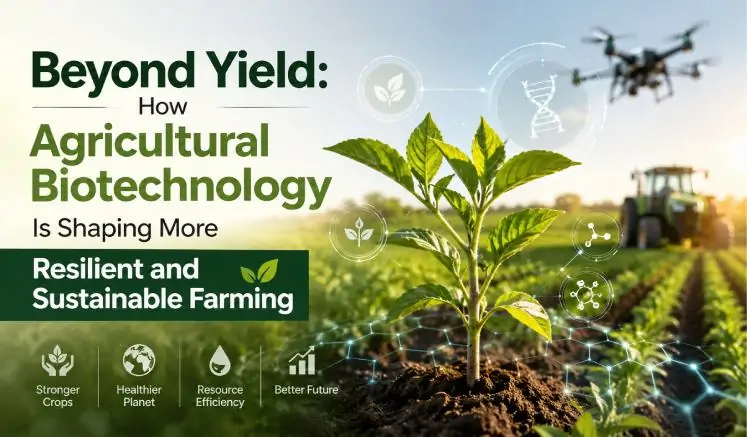
For decades, agricultural progress has often been measured by a simple question: how much can a field produce?
Yield remains important, but modern agriculture is being asked to solve a much larger problem. Farmers must maintain productivity while dealing with changing weather patterns, soil degradation, water constraints, biological pressures, and the rising need to use agricultural resources more efficiently.
That is changing the role of biotechnology in agriculture.
Today, biotechnology is no longer limited to conversations around genetic modification. The field encompasses a broad range of technologies and biological approaches, from improved crop genetics and disease diagnostics to microbial solutions, biofertilizers, bioprotection, and plant-supporting biological inputs.
The bigger opportunity lies in how these approaches can work alongside agronomy and sound crop management to build farming systems that are not simply productive, but more resilient.
The Agricultural Challenge Is Becoming More Complex
A crop rarely grows under ideal conditions from planting to harvest.
Temperature fluctuations, drought, excessive moisture, salinity, nutrient limitations, pests, and diseases can all interfere with crop development. Some stresses are immediately visible, while others begin affecting physiological processes before obvious symptoms appear.
This is why agricultural productivity cannot be viewed only through the lens of yield.
A crop that produces well under favourable conditions but struggles whenever the environment changes may not provide the same level of consistency as a crop with stronger resilience. For farmers, that distinction matters because production decisions are made in real-world environments rather than controlled conditions.
Agricultural biotechnology offers tools for addressing different parts of this challenge. FAO notes that crop biotechnology includes approaches such as tissue culture, marker-assisted selection, disease diagnostics, bioprotection, and biofertilization, among others.
The important point is not that one technology can solve every agricultural problem. Rather, biotechnology expands the range of tools available to understand, manage, and improve crop performance.
From Higher Yield to Better Crop Resilience
The next phase of agricultural innovation is increasingly concerned with how crops perform when conditions become less predictable.
Crop resilience involves the ability of plants and production systems to maintain function, recover from disturbances, and continue progressing through critical stages of development. This makes stress management an important part of modern crop strategy.
Research and development in agricultural biotechnology is already exploring ways to improve crop responses to environmental challenges, including drought, temperature extremes, salinity, and flooding.
At the same time, biological approaches can contribute to crop management through mechanisms involving nutrient availability, microbial interactions, plant growth, and protection from biological pressures.
This creates a broader perspective on bio products for agriculture. Instead of viewing biological products simply as alternatives to conventional inputs, they can be considered as components within integrated crop-management programmes.
Their value ultimately depends on the crop, environment, formulation, application strategy, and the specific biological or physiological objective being addressed.
Why Biological Solutions Matter for Sustainable Agriculture
Sustainability in agriculture is not simply about reducing one particular input.
A genuinely sustainable production system has to balance productivity, resource efficiency, soil and plant health, environmental considerations, and economic practicality.
This is where biotechnology can contribute to sustainable agriculture solutions.
For example, biological technologies can support approaches focused on nutrient management, biological protection, soil health, and crop resilience. FAO has highlighted the potential of agricultural biotechnology to contribute to sustainable production while conserving natural resources and improving the efficiency of agricultural systems.
However, biotechnology should not be treated as a replacement for agronomy.
The strongest outcomes are likely to come when biological technologies are integrated with appropriate crop management, good-quality planting material, irrigation practices, nutrition programmes, monitoring, and an understanding of local growing conditions.
In other words, the technology works within a farming system.
The Growing Role of an Agricultural Biotechnology Company
As agriculture becomes more science-driven, the role of an Agricultural Biotechnology Company is also evolving.
The focus is moving beyond simply developing a product and toward understanding the biological problem behind a crop-performance challenge.
That requires research, formulation expertise, field evaluation, application knowledge, and the ability to connect biological mechanisms with practical agricultural outcomes.
For agriculture biotech companies, this means innovation cannot happen in isolation. Products and technologies need to be developed around real agricultural requirements.
A biological solution that performs well in one crop or environment may not behave identically in another. Soil characteristics, climate, crop stage, application method, existing nutrient programmes, and stress conditions can all influence outcomes.
This makes scientific validation and responsible positioning particularly important.
Crop Stress Management Is Becoming a Strategic Priority
One of the clearest areas where biotechnology can contribute is crop stress management.
Stress is not a single phenomenon. Drought, salinity, heat, nutrient imbalance, and other environmental pressures can affect plants through different physiological pathways. The timing and intensity of stress also matter.
A crop experiencing stress during early establishment may face different consequences from one exposed during flowering, fruit set, or grain filling.
This is why modern Crop Stress Management Solutions increasingly need to focus on the biology of the plant rather than treating every stress event in exactly the same way.
The objective is not necessarily to eliminate stress—which is often impossible in field conditions—but to help crops maintain functional performance and recover appropriately when conditions become challenging.
India’s current biotechnology initiatives also reflect this broader direction, with research and development efforts covering climate-resilient crops, biological inputs, microbial strains, biostimulant activity, and technologies designed to improve input-use efficiency and resilience.
Soil and Microbial Biology Deserve More Attention
The future of agricultural biotechnology is not only above ground.
Soil is a biological environment, and the interactions between roots, microorganisms, organic matter, nutrients, and the surrounding environment influence how crops establish and develop.
This has increased interest in microbial technologies, biofertilizers, biostimulants, and other biological approaches that interact with crop and soil systems.
The opportunity is particularly relevant to sustainable farming because soil health cannot be separated from long-term agricultural productivity.
When biological approaches are appropriately integrated into crop programmes, they can become part of a broader strategy for improving nutrient-use efficiency, supporting plant development, and maintaining productive soils.
But again, context matters. Biological products should be selected and managed according to the crop, soil conditions, environmental situation, and intended agronomic objective rather than being treated as universal solutions.
Biotechnology Works Best as Part of a Larger System
One of the most important lessons from agricultural biotechnology is that technology alone is rarely enough.
FAO’s review of crop biotechnology in developing countries points to the importance of combining biotechnology with conventional breeding, agronomy, research capacity, extension systems, and farmer-relevant programmes.
This principle remains relevant today.
A resilient agricultural system may combine improved genetics with biological inputs, efficient irrigation, soil testing, precision monitoring, appropriate nutrition, integrated pest management, and better understanding of plant responses to environmental stress.
Each component addresses a different part of the production system.
The goal is therefore not to replace traditional agricultural knowledge with biotechnology. It is to strengthen decision-making by adding better biological understanding and more targeted tools.
What the Future of Agricultural Biotechnology May Look Like
The most interesting developments in agricultural biotechnology are likely to occur where different technologies begin working together.
Advances in molecular biology can improve understanding of crop traits. Microbial research can expand the potential of biological inputs. Sensors and precision agriculture can help identify stress and guide applications. Data-driven systems can make it easier to evaluate crop responses across different environments.
At the same time, biotechnology is expanding beyond the traditional boundaries of crop improvement. Current research includes microbial consortia, peptides, botanicals, novel microbial strains, marine biostimulants, genome editing, and genomic selection for climate resilience and input-use efficiency.
This convergence could make agricultural biotechnology increasingly practical and targeted.
The objective, however, should remain straightforward: help farmers produce reliably while using biological and physical resources more intelligently.
Moving Beyond the Yield Conversation
Yield will always matter.
But the future of agriculture cannot be defined by yield alone.
A productive crop that requires excessive resources or performs poorly under environmental pressure may not represent the most sustainable path forward. The more useful question is how agricultural systems can remain productive, adaptable, and economically viable as growing conditions become more challenging.
That is where agricultural biotechnology has an important role to play.
By combining biological science with agronomy, crop management, and responsible innovation, the industry can move toward solutions that focus not only on how much a crop produces, but also on how effectively it establishes, manages stress, uses resources, and maintains performance.
The future of farming will not be built around a single technology.
It will be built around better integration of technologies, biological understanding, and practical farm management.
And that is ultimately what makes agricultural biotechnology such an important part of the transition toward more resilient and sustainable agriculture.