
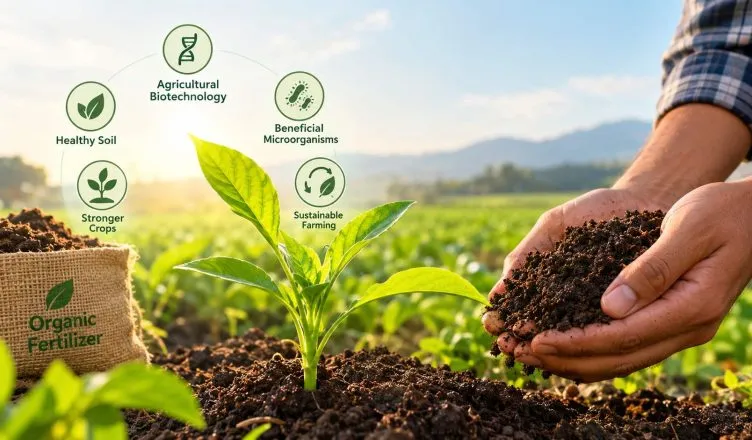
Agriculture is changing rapidly as farmers look for ways to improve crop productivity while maintaining soil health and using resources more responsibly. Alongside traditional farming practices, biotechnology is becoming an important part of this transition. From beneficial microorganisms to plant-based inputs, modern agricultural solutions are helping farmers address challenges related to nutrient availability, soil health, and changing environmental conditions.
An agricultural biotechnology company combines scientific research with practical agricultural applications to develop solutions that support healthier crops and more productive farming systems. In India, this field is particularly relevant because farmers operate across diverse soil types, climates, and cropping conditions.
What Is Agricultural Biotechnology?
Agricultural biotechnology involves using biological processes, microorganisms, natural compounds, and scientific techniques to develop products and solutions for agriculture.
These technologies can be used in areas such as:
- Soil health management
- Biofertilizers
- Biostimulants
- Plant growth support
- Biological crop protection
- Organic fertilizers
- Nutrient management
- Stress management
The objective is not simply to increase crop growth for one season. A more sustainable approach considers the relationship between plants, soil microorganisms, nutrients, and the surrounding environment.
This is where biotechnology-based agricultural inputs can complement conventional farming practices.
Why Agricultural Biotechnology Matters in India
India’s agricultural sector faces several challenges, including declining soil fertility in some regions, nutrient imbalance, water limitations, and environmental stresses affecting crop performance.
An agricultural biotechnology company in India can contribute by developing solutions suited to these challenges. Biological inputs can support nutrient availability, microbial activity, plant growth, and soil quality when used appropriately as part of an integrated crop management programme.
For example, biofertilizers use beneficial microorganisms to support nutrient-related processes in soil. Biostimulants can help plants respond more effectively to environmental stress and support physiological processes. Organic fertilizers, meanwhile, can contribute organic matter and nutrients while supporting healthier soil systems.
These approaches work best when selected according to crop requirements, soil conditions, and recommended application practices.
Understanding Organic Fertilizer for Plants
Organic fertilizers are derived from natural materials and can be used to supplement plant nutrition and improve soil conditions.
Unlike synthetic fertilizers that are primarily formulated around specific mineral nutrients, organic inputs can also contribute organic matter and support biological activity in the soil.
Common sources of organic fertilizer include composted plant material, animal-derived materials, crop residues, and other decomposed organic matter.
The value of an organic fertilizer for plants depends on its composition, maturity, nutrient availability, and how it is applied. Simply choosing a product because it is labelled organic does not guarantee the same result for every crop.
Farmers and growers should therefore consider the crop, soil condition, nutrient requirements, application method, and recommended dosage before selecting an organic input.
How Natural Organic Fertilizers Can Support Soil Health
Healthy soil is more than a medium in which plants grow. It is a living system containing microorganisms, organic matter, minerals, air, and water.
Natural organic fertilizers can contribute to this system in several ways.
1. Supporting Soil Organic Matter
Organic materials can help replenish organic matter that may decline through intensive cultivation and other agricultural practices.
Maintaining organic matter is important for soil structure and the overall functioning of the soil ecosystem.
2. Improving Nutrient Cycling
Microorganisms play an important role in breaking down organic materials and making nutrients available through natural soil processes.
Well-managed organic inputs can therefore become part of a broader nutrient-cycling strategy.
3. Supporting Beneficial Microbial Activity
Soil microorganisms interact with plant roots and organic materials in complex ways. Agricultural biotechnology can help harness beneficial microorganisms for applications related to nutrient availability and plant development.
4. Reducing Organic Waste
Some agricultural and plant-based materials can be converted into useful soil amendments rather than being discarded.
This creates an opportunity to connect agricultural productivity with better resource utilisation.
Organic Fertilizers and Biotechnology Can Work Together
Organic fertilizers and biotechnology should not necessarily be viewed as separate approaches.
Modern agricultural solutions can combine organic materials, beneficial microorganisms, nutrients, and plant-derived compounds to address different aspects of crop production.
For example, microbial cultures can support the decomposition of organic matter. Biofertilizers can assist specific nutrient-related processes, while biostimulants may support plant growth and resilience.
Trishul Biotech develops agricultural products across categories including organic fertilizers, biofertilizers and biostimulants, with a focus on soil health, plant health and sustainable agricultural practices. Its UpCrop platform brings together different biological and natural-input technologies for agricultural applications.
Choosing Natural Organic Fertilizers for Different Crops
There is no universal fertilizer that is ideal for every plant or farming situation.
Before selecting a product, growers should consider:
- Type of crop
- Growth stage
- Soil condition
- Existing nutrient levels
- Organic matter content
- Water availability
- Application method
- Recommended dosage
For home gardeners, the requirements may differ considerably from those of commercial farms. Similarly, fruit crops, vegetables, cereals, pulses, and plantation crops can have different nutritional requirements.
A scientific approach to fertilizer selection can therefore help avoid unnecessary application and improve the efficiency of agricultural inputs.
The Future of Sustainable Agriculture
The future of agriculture will likely depend on combining different technologies and management practices rather than relying on one solution.
Agricultural biotechnology can contribute to this transition by turning biological knowledge into practical products for farmers. Advances in microbial technology, seaweed-based inputs, plant-derived compounds, and biological crop management are creating new possibilities for sustainable agriculture.
For an agricultural biotechnology company, the challenge is to ensure that innovation remains practical, scalable, and relevant to real farming conditions.
The goal should ultimately be healthier soils, stronger crops, efficient nutrient use, and productive farming systems that can remain viable over the long term.
Conclusion
Agriculture needs solutions that support both productivity and environmental responsibility. Organic fertilizers and biotechnology-based agricultural inputs can play complementary roles in achieving this balance.
Natural organic fertilizers can contribute to soil fertility and organic matter management, while biotechnology can provide targeted biological solutions for nutrient availability, plant growth, and crop resilience.
As research and innovation continue to develop, agricultural biotechnology companies in India have an opportunity to help farmers adopt more sustainable and scientifically informed approaches to crop production.