
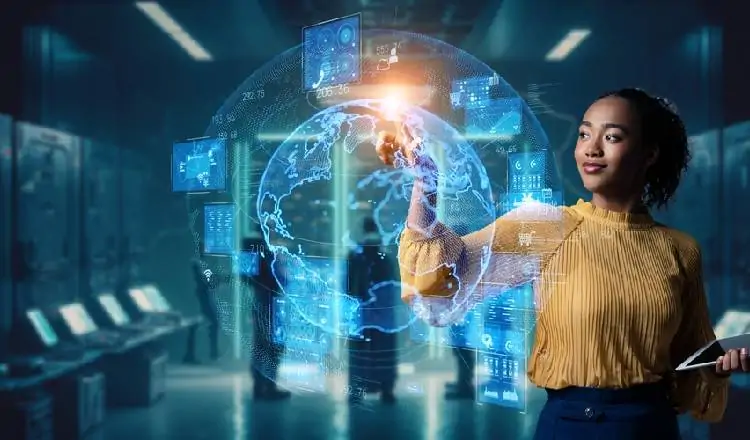
Business training has always been about more than passing knowledge from one person to another. It’s about creating real understanding, building confidence, and preparing teams for challenges they’ll face in the workplace. Traditional training methods—slides, manuals, and lectures—have their place, but they rarely capture attention the way interactive, immersive learning can. This is where a mixed reality development company comes into play, reshaping how organizations approach skill-building and professional growth.
Understanding Mixed Reality in the Business World
Mixed reality (MR) blends digital elements with the real environment, allowing users to interact with both at once. Unlike virtual reality, which places learners inside a fully digital world, MR overlays digital information into real surroundings, enhancing awareness while keeping physical context intact.
For business training, this means employees don’t just “read about” processes—they practice them. They don’t only hear about safety procedures—they walk through them with step-by-step digital guidance layered into their physical workspace. The result is learning that feels active, natural, and deeply memorable.
From Theory to Experience – Why Mixed Reality Works
Learning is most effective when people are engaged. Hands-on practice, repetition, and real-time feedback help information stick. Mixed reality offers exactly that. It transforms abstract theories into practical experiences.
For example:
- A finance trainee can visualize data dashboards in 3D, walking around projections and interacting with figures.
- A factory worker can rehearse machine operations with digital overlays that guide each step without halting production.
- Customer service teams can roleplay client interactions in realistic simulations, preparing them for real-world scenarios.
Instead of training sessions that fade from memory, employees retain skills because they’ve experienced them firsthand.
Role of a Mixed Reality App Development Company
Turning this vision into reality requires more than off-the-shelf software. A mixed reality app development company builds customized solutions tailored to specific industries and organizations. They consider not only the technical architecture but also the psychology of learning.
The process usually involves:
- Needs assessment: Understanding what skills or procedures employees must master.
- Scenario building: Designing real-world environments or simulations that mirror actual job tasks.
- App development: Crafting applications that merge digital elements with physical space in a seamless way.
- Integration: Ensuring the solution works with existing systems, devices, and workflows.
By blending creativity with technical expertise, these companies create tools that not only train but empower.
Industries Embracing Mixed Reality Training
Mixed reality training isn’t confined to one sector. Different industries are adopting it in unique ways:
- Healthcare: Surgeons practice procedures with holographic overlays, reducing errors in real operations.
- Manufacturing: Workers train on complex machinery using guided simulations, avoiding costly downtime.
- Retail: Staff learn how to handle customers through role-play experiences that feel like live interactions.
- Corporate offices: Teams sharpen presentation or negotiation skills in immersive boardroom simulations.
Each use case highlights the adaptability of MR—it molds itself to the needs of the business, regardless of scale or specialization.
Benefits That Go Beyond Traditional Training
Why are businesses so eager to adopt MR training? The benefits are hard to ignore:
- Higher engagement: Employees actively participate instead of passively listening.
- Faster learning curves: Skills are retained longer when learned through action.
- Safe practice: Risky or high-stakes tasks can be rehearsed without danger.
- Scalability: Once developed, programs can be rolled out across global teams with consistency.
- Cost efficiency: Though initial setup may require investment, MR reduces repeated training sessions and errors, saving resources in the long run.
These advantages make MR a smart choice for organizations seeking both effectiveness and innovation.
Bridging Training With Real-World Application
The strength of mixed reality lies in its ability to connect theory with real-world application. Employees can train on the same equipment, within the same environments, or under conditions nearly identical to those they’ll face daily. That bridge eliminates the gap between learning and doing, making lessons instantly relevant and practical.
A mixed reality app development company doesn’t just create simulations; it builds learning ecosystems. These ecosystems evolve with business needs, integrating new processes or technologies as they emerge. This means employees aren’t just trained once—they’re continuously supported, with updates and improvements woven into their daily workflows for long-term growth.
Future Possibilities – From Training to Transformation
What makes mixed reality exciting is its potential to keep growing. Imagine onboarding new hires through immersive company tours without leaving their desks. Picture global teams collaborating in holographic environments, learning together despite being continents apart, breaking the limitations of geography and traditional classroom setups.
As technologies advance, MR will increasingly overlap with AI and automation, creating training programs that adjust dynamically to each learner’s pace and progress. This level of personalization ensures everyone—from entry-level staff to senior executives—receives the right level of challenge and guidance. The result is a training approach that scales seamlessly with both people and organizations.
Conclusion – The Larger Impact
The influence of a mixed reality development company extends beyond just business training. It represents a shift toward experiential learning—where knowledge is absorbed not by reading or listening, but by doing. And that shift doesn’t just prepare employees better; it empowers organizations to innovate faster.
As MR converges with the innovations of a metaverse development company, the opportunities for immersive business learning will only expand. From safer training in high-risk industries to global collaboration across borders, the future is about experiences that feel real and deliver results.
Brands like Rwizen are at the forefront of showcasing how these possibilities turn into practical solutions—solutions that reshape training, drive efficiency, and unlock human potential in entirely new ways.