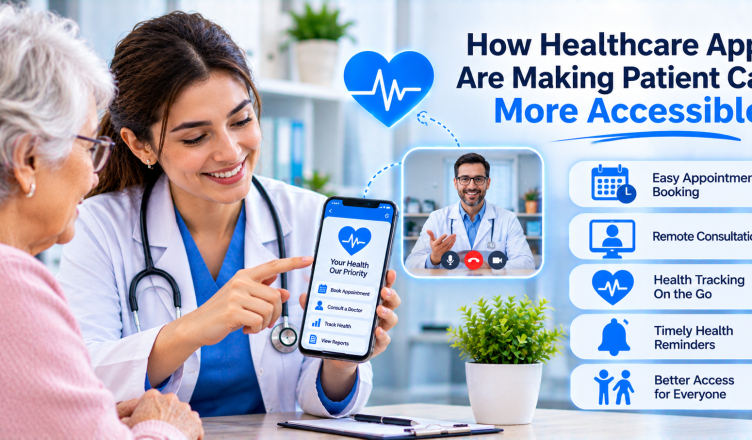
Samira coordinates patient services at a community health center in Minneapolis. Her patients speak Somali, Hmong, Spanish, Oromo, and English, sometimes all within one family. Many work two jobs. Many rely on a bus, a ride from a cousin, or a sister who translates over the phone. For years she watched capable, motivated people miss appointments for reasons that had nothing to do with motivation: a letter written in English that nobody could read, a reminder call that came during a night shift, a form that asked for information the patient didn’t have in front of them.
When her board approved a budget for a patient app, she did something that surprised the first Healthcare App development Company she spoke with. She asked to see how the app would work for a grandmother who couldn’t read English, using a shared phone, with no data plan to spare. The meeting went quiet for a moment. Then it got interesting.
Her project is a useful way to see what accessibility in healthcare technology really means. Here is what it took.
Access Is Bigger Than Broadband
When people talk about digital health access, they often mean internet speed. That matters, but it’s only one barrier among several.
There is language, since a portal available only in English excludes a large share of patients no matter how clean the design is. There is literacy, because health information written at a college reading level fails many people who speak English fluently. There is time, because a patient who can’t take an unpaid hour off work for a clinic visit needs another option. There is transportation, cost, disability, and trust, particularly for communities that have had negative experiences with health systems.
Samira’s team listed these before choosing any features. Each feature had to answer a specific barrier, or it didn’t make the cut.
Language Access That Goes Beyond Translation
Federal rules require health programs that receive federal funding to provide meaningful access for people with limited English proficiency, under Section 1557 of the Affordable Care Act. But compliance is the floor. A good experience requires thinking about how people actually communicate.
Samira’s app launched in English, Spanish, Somali, and Hmong, with Oromo added later. Translation was reviewed by native speakers who work in healthcare, because a word-for-word translation of a medical instruction can be confusing or even offensive. A medication label that says “take with food” needs context, not just vocabulary.
The app also supported audio. Many patients prefer to listen rather than read, and some languages have varied written conventions. Short recorded explanations, voiced by clinic staff the patients already knew, increased completion of pre-visit questionnaires noticeably.
When a video visit was needed, the app could connect a clinician and a patient with a professional interpreter on the same call. No more passing the phone to a teenager to translate a diagnosis.
Telehealth That Fits Real Lives
Video visits are now a normal part of healthcare, and Telemedicine App Development involves a good deal more than adding a camera button. The experience has to work on older phones, on poor connections, and for people who have never used video calling. It needs a waiting room that doesn’t confuse people, a link that works without creating yet another account, and a fallback to a regular phone call when video fails.
Samira’s team built a simple join flow. A patient taps a text message link, confirms their name, and enters a virtual waiting room. If the video connection is weak, the app offers an audio-only option automatically. Clinicians can also add a family member or interpreter to the call with a single tap.
Behind the scenes, video and messaging needed to follow HIPAA requirements, which meant vendors that would sign business associate agreements. The team used a compliant video provider rather than building a call system from scratch, a common and sensible choice.
Reminders That Actually Reach People
Missed appointments are a quiet driver of poor health outcomes and a major source of lost clinic capacity. Reminders help, but only if they arrive in a form people use.
Many of Samira’s patients rarely checked email. Text messages worked better, in the patient’s preferred language, with a simple option to confirm, reschedule, or cancel by replying. Twilio handled message delivery, and the app showed the same information for patients who preferred to use it directly.
The team also learned to adjust timing. A reminder the night before was often too late for patients who needed to arrange childcare or time off work. They moved the first reminder to three days before and added a second the morning of the visit.
Caregivers, Families, and Proxy Access
A lot of healthcare happens through family. Adult children manage the care of aging parents. Parents book for their kids. Neighbors and community members help patients navigate systems that feel unfamiliar.
Proxy access allows an authorized person to view appointments, medications, and messages on a patient’s behalf. It needs careful design, since privacy rules apply and a patient must control who can see what. Samira’s app let patients invite a caregiver, choose which information they could access, and revoke access at any time. For minors and certain sensitive services, the rules differ, so the team worked with the clinic’s compliance officer on the logic.
This feature became one of the most used in the first year, which surprised the developers more than it did Samira.
Records, Portals, and Interoperability
Patients increasingly expect to see their own records: lab results, visit summaries, and medication lists. Access to that information helps people stay involved in their care, and federal rules have pushed health systems to make it easier.
Behind the scenes, apps connect to electronic health record systems through standards like FHIR. Large systems such as Epic provide patient-facing tools, and many clinics integrate with them rather than rebuilding from scratch. The integration is often the slowest part of a project, because the app is only as useful as the data it can reach.
Samira’s team spent nearly a third of the timeline on the connection to the clinic’s record system, and says that was money well spent.
Making Apps Usable for People With Disabilities
Accessibility for people with disabilities needs to be built in from the start. That includes screen reader support through VoiceOver and TalkBack, adjustable text sizes, strong color contrast, captioned video, and large tap targets. The widely used standard is WCAG, and health programs are subject to disability nondiscrimination rules.
Samira’s team tested with patients who had low vision, hearing loss, and limited dexterity. A man who used a screen reader told them the appointment screen read out the date and time in the wrong order, a small bug that would have made the app unusable for him. It was fixed within a day.
What It Costs
Leaders always ask about money first, and the honest answer is a range. A focused patient app with multilingual support, scheduling, messaging, reminders, video visits, and an EHR connection commonly lands between $90,000 and $250,000, depending on integrations and compliance work. Maintenance usually adds fifteen to twenty percent of the build each year, and security testing shouldn’t be trimmed.
Samira’s first release came to roughly $165,000, funded in part by a grant. She says the best-value decision was to launch with fewer features and test with patients before adding more.
What Changed
After the first year, missed appointments dropped meaningfully, and patients completed more pre-visit forms before arriving. Interpreter-supported video visits became routine for follow-ups that once required a trip across town. Staff spent less time on reminder calls and more time on patients who needed personal outreach.
Samira is careful not to oversell it. The app didn’t fix transportation, housing, or trust. Some patients still prefer to talk to a person, and the clinic keeps phone lines open for them. But for patients who once felt that the system wasn’t built for them, being able to see their care in their own language, on their own schedule, made a difference.
Accessibility in healthcare isn’t a feature. It is the habit of asking, at every step, who is being left out, and then building something that includes them.