
India’s solar industry is entering a new phase in 2026. Solar power is no longer only about adding more megawatts of generation capacity; the country is increasingly focused on manufacturing the solar panels, cells and components needed to support that growth domestically.
The expansion is visible across the manufacturing value chain. According to the Ministry of New and Renewable Energy (MNRE), India’s solar module manufacturing capacity listed under the Approved List of Models and Manufacturers (ALMM) reached around 144 GW per year by the end of 2025, while around 24 GW of solar cell capacity had been enlisted under ALMM List-II. MNRE also reported that about 81 GW of ALMM-listed module capacity was added during 2025.
For solar module manufacturers, developers, EPC companies and customers, this growth is changing the market. Technologies such as N-Type TOPCon bifacial modules, half-cut cells and higher-wattage modules are becoming increasingly important, while government policies are encouraging a stronger domestic manufacturing ecosystem.
In this changing environment, Bluebird Solar is building its presence as an Indian solar PV module manufacturer with a focus on advanced module technology and automated manufacturing.
India’s Solar Manufacturing Industry in 2026
India has traditionally depended heavily on imported solar cells and other components even as domestic module assembly expanded. The policy direction is now moving toward greater integration of the manufacturing chain.
The government’s Production Linked Incentive (PLI) programme for high-efficiency solar PV modules has an approved outlay of ₹24,000 crore. MNRE says the programme is intended to create GW-scale manufacturing capacity, encourage advanced technologies, develop integrated manufacturing plants and reduce dependence on imports.
The programme has supported manufacturers across different stages of the solar PV value chain. Under PLI Tranche-I, awards were issued for 8,737 MW of fully integrated manufacturing capacity, while Tranche-II awarded capacity for 39,600 MW of fully or partially integrated solar PV manufacturing.
This shift matters because a solar panel is only one part of a much larger manufacturing ecosystem.
The broader value chain includes:
Polysilicon → Ingots → Wafers → Solar Cells → Solar Modules → Solar Power Projects
India is expanding its capabilities across several of these stages, although the depth of domestic manufacturing varies between different components.
What Is Driving Solar Panel Manufacturing Growth in India?
Several factors are contributing to the rapid expansion of Indian solar manufacturing.
1. Growing Domestic Solar Demand
India continues to add solar power across utility-scale projects, commercial and industrial installations, rooftop systems, solar pumps and other applications.
Higher deployment naturally creates demand for solar PV modules. As the market grows, developers increasingly need reliable access to modules that meet applicable domestic requirements.
2. Government Manufacturing Policies
Manufacturing policies such as the PLI scheme are designed to encourage investment in high-efficiency solar PV manufacturing.
The objective is not simply to increase the number of factories. The policy framework also encourages technology improvement, integration and domestic supply-chain development.
3. ALMM and Domestic Manufacturing
The Approved List of Models and Manufacturers (ALMM) is an important part of India’s solar manufacturing ecosystem.
MNRE states that models and manufacturers included in ALMM List-I are eligible for use in government projects, government-assisted projects and certain other specified project categories in India.
India also introduced ALMM List-II for solar cells in 2025. MNRE has continued updating the cell list during 2026, reflecting the country’s move toward greater domestic cell sourcing.
For manufacturers and project developers, compliance with these requirements has therefore become an important consideration when selecting PV modules.
Solar Panel Technology in India: From Mono PERC to TOPCon
Solar manufacturing is not simply expanding in terms of volume. The technology used to manufacture modules is also changing. For many years, Mono PERC became one of the dominant crystalline-silicon technologies used in mainstream solar modules.
The industry is now moving increasingly toward N-Type TOPCon and other high-efficiency technologies.
What Is TOPCon Technology?
TOPCon stands for Tunnel Oxide Passivated Contact.
It is an N-type solar cell architecture designed to improve the electrical performance of the cell by reducing recombination losses at the contact interface.
In practical terms, TOPCon technology can support:
- Higher module efficiency
- Higher power output from a similar module footprint
- Good performance in different operating conditions
- Better suitability for large-scale solar installations
- Continued development toward higher-wattage modules
The transition toward TOPCon is part of a wider industry movement toward high-efficiency solar modules.
Bluebird Solar’s current portfolio includes N-Type TOPCon modules alongside Mono PERC modules, with TOPCon products listed in power ranges extending up to 645 Wp.
Bifacial and Half-Cut Solar Modules
TOPCon is not the only technology influencing modern solar modules.
Two other important developments are half-cut cells and bifacial modules.
Half-Cut Technology
A half-cut module uses solar cells divided into smaller sections.
This configuration can help reduce electrical losses within the module and improve the way the panel performs under partial shading and other operating conditions.
Bifacial Technology
Bifacial solar panels can generate electricity from light reaching both sides of the module. This makes them particularly relevant for installations where reflected or scattered light can reach the rear side of the panel.
Bluebird Solar manufactures both Mono PERC and N-Type TOPCon modules, including monofacial and bifacial configurations. Its published product range covers modules from approximately 480 Wp to 645 Wp, depending on the technology and model.
The Rise of High-Wattage Solar Panels
Another visible trend in India’s solar market is the movement toward higher-wattage modules.
Older residential and commercial installations commonly used modules in lower power categories. Modern manufacturers are increasingly producing modules in the 500 Wp, 550 Wp, 600 Wp and higher power ranges.
Higher module wattage can be particularly useful for large projects because fewer modules may be required to reach a particular installed capacity, potentially simplifying some aspects of installation and balance-of-system planning.
However, module wattage alone should not determine product selection.
Developers should also consider:
- Module efficiency
- Temperature coefficient
- Degradation characteristics
- Mechanical load ratings
- Bifacial gain where applicable
- Product and performance warranties
- Certifications
- ALMM status where applicable
- Availability and after-sales support
Companies Driving India’s Solar Manufacturing Growth
India’s solar manufacturing landscape now includes established module manufacturers, newer high-capacity facilities and companies expanding backward into cells, wafers and other parts of the supply chain.
Some manufacturers are focusing primarily on module production, while others are developing increasingly integrated manufacturing capabilities.
The government’s PLI programme has also encouraged companies to establish or expand high-efficiency manufacturing facilities. MNRE reports that PLI beneficiaries installed approximately 11 GW of solar module manufacturing capacity and around 5 GW of solar cell manufacturing capacity during 2025 under the scheme.
This combination of policy support, domestic demand and technology investment is reshaping India’s solar manufacturing sector.
Bluebird Solar: Growing with India’s Solar Manufacturing Market
Among India’s solar module manufacturers, Bluebird Solar is developing its manufacturing capabilities around high-efficiency PV technologies.
According to the company’s published information, Bluebird Solar operates a 2.5 GW automated manufacturing facility in Greater Noida, Uttar Pradesh, and manufactures N-Type TOPCon and Mono PERC solar PV modules. The company says its modules are available in monofacial and bifacial configurations and in both DCR and non-DCR variants.
Its current product portfolio includes:
- N-Type TOPCon Solar Panels
- Mono PERC Half-Cut Solar Panels
- Bifacial Solar Modules
- DCR Solar Modules
- Non-DCR Solar Modules
- High-wattage modules extending up to the 645 Wp range
The company also states that its modules are manufactured to applicable BIS, IEC and ALMM requirements, depending on the specific product/model.
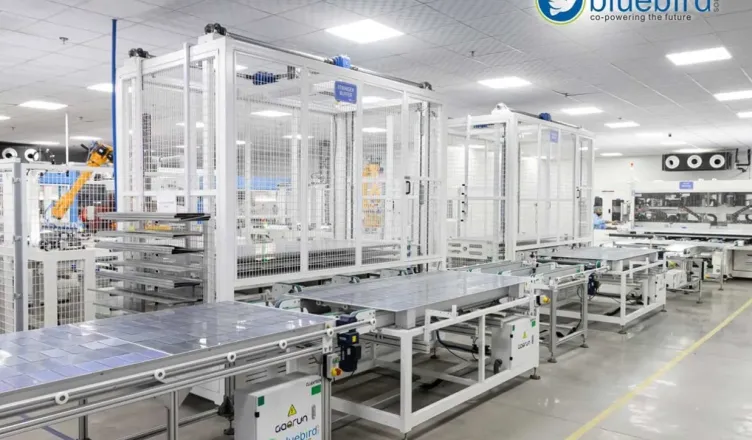
Bluebird Solar’s manufacturing infrastructure includes automated tabber and stringer equipment, robotic layup and bussing systems, automated lamination and framing processes, and EL testing as part of its quality-control process.
For a manufacturer, these processes are important because module reliability depends not only on the underlying cell technology but also on how cells are interconnected, laminated, tested and assembled.
Choosing a Solar Panel Manufacturer in India
As manufacturing capacity expands, buyers will have more choices. But choosing a manufacturer should go beyond comparing the wattage or price printed on a module.
Before purchasing solar panels, consider:
- Technology – TOPCon, Mono PERC or another cell technology.
- Module efficiency – especially when installation space is limited.
- Certification – check applicable BIS, IEC and ALMM documentation.
- Product warranty – understand what is actually covered.
- Performance warranty – review the degradation and guaranteed output terms.
- Manufacturing quality – ask about testing and quality-control procedures.
- DCR requirement – important for projects where domestic-content rules apply.
- After-sales support – particularly for commercial and utility-scale installations.
- Manufacturer experience – consider manufacturing history, project experience and supply capability.
- Product availability – consistent supply can be important for large projects.
The Road Ahead for Indian Solar Manufacturing
India’s solar manufacturing industry has moved well beyond the early stage of simply assembling PV modules.
With around 144 GW of ALMM-listed module manufacturing capacity reported by MNRE at the end of 2025, continued expansion in cell manufacturing, large government-backed manufacturing programmes and increasing adoption of high-efficiency technologies, the industry is developing rapidly.
The transition from Mono PERC toward N-Type TOPCon and other advanced technologies is also changing what customers expect from a modern solar module.
For manufacturers such as Bluebird Solar, this creates an opportunity to combine domestic manufacturing with higher-efficiency technologies, automation and quality-focused production.