
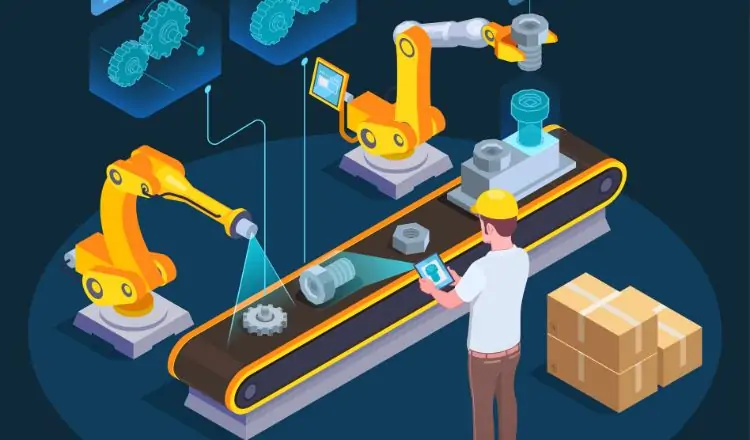
The manufacturing industry is undergoing a seismic shift. As we progress into 2025, artificial intelligence (AI) is no longer a futuristic concept but a core operational tool. From predictive maintenance to robotic automation, AI is helping manufacturers become more agile, efficient, and resilient.
In this blog, we’ll explore the most effective AI solutions for manufacturing in 2025, how they’re transforming factories into smart ecosystems, and why businesses must adopt these innovations to stay competitive.
1. Predictive Maintenance: Minimizing Downtime
Unplanned downtime has always been a costly issue in manufacturing. One of the most impactful AI solutions for manufacturing is predictive maintenance. Using machine learning algorithms and real-time sensor data, AI can detect anomalies in equipment behavior before they lead to failures.
How it works:
Sensors collect data on temperature, vibration, sound, and energy usage.
AI models analyze patterns and identify early signs of wear or malfunction.
Maintenance teams receive alerts before a breakdown occurs.
Benefits:
Reduces downtime by up to 30–50%
Extends equipment lifespan
Lowers maintenance costs
In 2025, manufacturers are increasingly integrating predictive maintenance into their production workflows using platforms like IBM Maximo and Siemens MindSphere.
2. Quality Control with Computer Vision
Manual inspection of products is not only labor-intensive but prone to errors. AI-powered computer vision systems have emerged as powerful tools for automating quality control.
How it works:
High-resolution cameras scan products in real-time.
Deep learning models detect defects, misalignments, and inconsistencies.
The system learns and improves accuracy over time.
Benefits:
Increases inspection speed and accuracy
Reduces waste and recalls
Ensures consistent product quality
AI solutions like Landing AI and Amazon Lookout for Vision are being widely adopted across sectors such as automotive, electronics, and food processing.
3. Robotics and Intelligent Automation
The integration of AI with robotics has led to intelligent automation — a game-changer for the manufacturing industry. Unlike traditional robots, AI-powered robots can learn, adapt, and collaborate with humans.
Examples:
Cobots (collaborative robots) that assist workers on assembly lines
Autonomous mobile robots (AMRs) for material handling and logistics
AI-driven robotic arms for precise tasks like welding or painting
Benefits:
Improves productivity and safety
Reduces human error
Enables 24/7 operations
In 2025, companies like FANUC, ABB, and Universal Robots are leading the charge with scalable, AI-integrated robotic solutions for all manufacturing sizes.
4. Digital Twins and Simulation
Digital twin technology — a virtual replica of physical systems — is being supercharged by AI. It allows manufacturers to simulate, monitor, and optimize production processes in real-time.
How AI Enhances Digital Twins:
Simulates production scenarios under various conditions
Analyzes sensor data to predict outcomes
Continuously updates models with real-world feedback
Benefits:
Enhances operational visibility
Aids in proactive decision-making
Improves product design and development
With tools like Siemens’ Digital Twin Suite and GE’s Predix, digital twins are becoming central to AI solutions for manufacturing in 2025.
5. Supply Chain Optimization
AI is revolutionizing supply chain management by bringing intelligence, speed, and adaptability. Using predictive analytics, demand forecasting, and autonomous planning, manufacturers are gaining control over global supply chain uncertainties.
Capabilities:
AI forecasts demand with higher precision
Identifies potential disruptions in real-time
Automates procurement and inventory decisions
Benefits:
Reduces inventory costs
Enhances responsiveness to market changes
Ensures timely delivery and customer satisfaction
AI platforms like Blue Yonder and Llamasoft (acquired by Coupa) offer end-to-end supply chain optimization powered by machine learning.
6. Energy Efficiency and Sustainability
In a world facing climate challenges, sustainable manufacturing is a necessity. AI is playing a critical role in energy optimization, waste reduction, and sustainable resource management.
How AI Helps:
Monitors energy consumption and recommends efficiency improvements
Optimizes heating, cooling, and lighting in facilities
Reduces material waste in production
Benefits:
Cuts energy costs by up to 20–30%
Supports carbon neutrality goals
Enhances brand reputation
Solutions from Schneider Electric’s EcoStruxure and Google’s DeepMind are helping manufacturers operate greener and leaner in 2025.
7. Generative Design and Product Innovation
Generative design is a cutting-edge application of AI that’s transforming product development. Engineers input constraints (like materials, weight, strength), and AI algorithms generate thousands of design alternatives.
Features:
AI proposes innovative shapes and configurations
Designs are tested virtually for performance
Speeds up R&D cycles significantly
Benefits:
Accelerates time-to-market
Reduces material usage
Enhances product functionality
Platforms such as Autodesk’s Fusion 360 and nTopology are enabling smarter, more efficient design processes using AI.
8. Human-AI Collaboration and Workforce Augmentation
Rather than replacing human workers, the most successful AI solutions for manufacturing in 2025 augment human capabilities. AI supports workers with real-time data, insights, and digital tools to enhance decision-making.
Examples:
AI-powered dashboards for factory managers
Augmented reality (AR) tools for technicians
Voice-enabled AI assistants for assembly instructions
Benefits:
Reduces human error
Improves training and safety
Increases job satisfaction and performance
With companies investing in reskilling and upskilling programs, human-AI synergy is becoming a cornerstone of the smart factory.
9. AI-Driven ERP and MES Integration
Manufacturers are integrating AI into their ERP (Enterprise Resource Planning) and MES (Manufacturing Execution Systems) to gain better control and visibility across operations.
Capabilities:
AI identifies bottlenecks in production lines
Automates scheduling and resource allocation
Provides predictive insights for capacity planning
Benefits:
Optimizes end-to-end operations
Improves agility and responsiveness
Facilitates data-driven decision-making
SAP, Oracle, and Microsoft Dynamics 365 have embedded AI into their manufacturing modules, offering more intelligent and adaptive business operations.
Conclusion
As 2025 unfolds, the adoption of AI solutions for manufacturing is not just an option—it’s a strategic necessity. Whether it’s improving uptime, reducing costs, ensuring quality, or enabling sustainability, AI is powering the factories of the future.
Key Takeaways:
AI is enabling smarter, faster, and safer manufacturing.
Successful AI implementation requires a combination of the right technology, data infrastructure, and workforce readiness.
Companies investing in AI today are better positioned for long-term competitiveness and innovation.
From large-scale enterprises to small manufacturers, the AI revolution is leveling the playing field and opening up new horizons of possibility.