
Ask a group of parents what they want from a school, and the answers usually begin with academics. Good results. Strong teachers. Future opportunities.
Keep the conversation going for another five minutes, though, and something interesting happens.
Parents start talking about confidence. Curiosity. Communication. Adaptability. They want children who can think independently, not simply follow instructions. They want learners who can navigate unfamiliar situations with ease, collaborate with others, and remain curious long after the examination season ends.
That shift in expectations is one reason why many families are paying closer attention to the learning environments created by the best IB schools in Pune.
At first glance, the difference may not always be obvious. Students attend classes. Teachers guide lessons. Assessments still exist. Yet underneath the surface, the educational experience often feels very different. The focus extends beyond memorizing information. The goal is to develop thinkers, problem-solvers, researchers, communicators, and responsible global citizens.
To understand why this approach continues to attract attention, it helps to step inside the everyday learning experience itself.
Learning Begins With Questions, Not Answers
Walk into a conventional classroom, and a lesson often starts with information. Walk into an IB-inspired learning environment, and a lesson may begin with a question. A surprisingly simple question.
- Why do communities develop near rivers?
- How does technology influence human behavior?
- What makes a system fair?
Questions like these encourage students to investigate rather than simply absorb information. Instead of being handed answers immediately, learners are encouraged to:
- Research
- Observe
- Discuss
- Analyze
- Challenge assumptions
- Draw conclusions
This creates a very different classroom atmosphere. Students become active participants in learning rather than passive recipients of information.
The result is often a deeper understanding and stronger engagement.
The Classroom Extends Beyond Four Walls
One of the defining characteristics of modern IB learning is that education is rarely confined to a textbook. Learning happens through experiences.
Sometimes that means collaborative projects. Sometimes it means field-based observations. Sometimes it means community engagement activities. The objective is to connect learning with real life.
Students are encouraged to understand not only what they are learning but also why it matters.
Traditional Learning vs Inquiry-Based Learning
| Traditional Approach | Inquiry-Based Approach |
| Information first | Questions first |
| Teacher-led instruction | Guided exploration |
| Fixed answers | Multiple perspectives |
| Subject isolation | Interdisciplinary learning |
| Exam-focused outcomes | Conceptual understanding |
| Knowledge recall | Knowledge application |
This shift may appear subtle on paper. In practice, it transforms how students engage with education.
Students Learn How to Think
Perhaps one of the most overlooked aspects of modern education is the difference between learning content and learning how to think.
Content changes constantly.
The facts students memorize today may evolve tomorrow.
Critical thinking, however, remains valuable regardless of changing industries or technologies.
Within many International Baccalaureate schools in Pune, students are regularly encouraged to:
- Evaluate evidence
- Compare viewpoints
- Analyze sources
- Identify bias
- Form independent conclusions
These habits become part of everyday learning rather than occasional classroom exercises.
Over time, students begin approaching challenges with greater confidence because they know how to investigate, interpret, and assess information independently.
Collaboration Becomes Part of Daily Learning
The image of students quietly working alone at separate desks still exists in many educational settings.
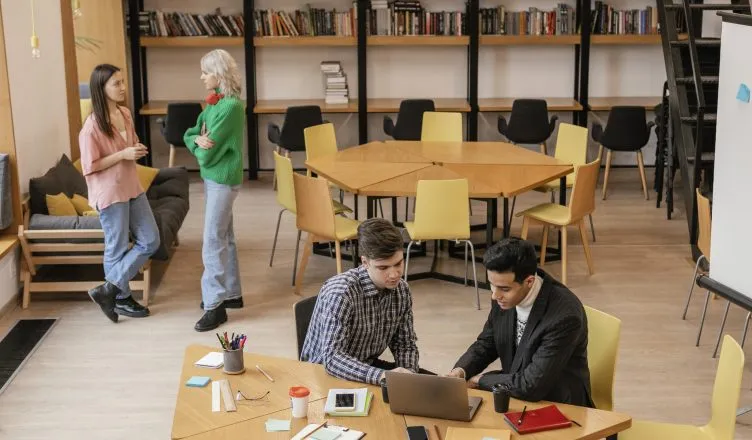
IB classrooms often look different.
Collaboration is woven into the learning process.
Students frequently work together to:
- Solve problems
- Conduct research
- Present findings
- Design projects
- Debate ideas
The purpose is not merely teamwork.
The purpose is to learn how to communicate effectively with people who may think differently.
In today’s interconnected world, that skill matters more than ever.
Employers consistently value collaboration, communication, and adaptability. Strong schools recognize that these abilities begin developing long before students enter the workforce.
Assessment Looks Beyond Marks
One of the most common misconceptions about progressive education is that academic standards become less important.
The reality is more nuanced. Academic achievement remains important. The difference lies in how progress is evaluated.
Alongside traditional assessments, students may also demonstrate learning through:
| Assessment Type | Purpose |
| Research Projects | Analytical thinking |
| Presentations | Communication skills |
| Reflective Journals | Self-awareness |
| Collaborative Tasks | Teamwork development |
| Investigations | Inquiry skills |
| Portfolios | Long-term growth tracking |
This broader perspective provides a more complete picture of student development. A test score reveals one aspect of learning. A combination of assessments reveals much more.
Global Awareness Is Integrated Into Learning
Modern students will live and work in an increasingly interconnected world. As a result, many educational programs place significant emphasis on global understanding. This does not simply mean learning about different countries.
It involves examining issues from multiple perspectives and developing awareness of how local and global systems interact.
Students may explore topics such as:
- Sustainability
- Cultural diversity
- Ethical decision-making
- Human rights
- Innovation
- Global citizenship
The objective is to help learners understand their role within a broader global community.
This perspective is one reason many parents consider International Baccalaureate schools in Pune when evaluating long-term educational pathways.
Reflection Is Treated As a Learning Tool
In many traditional classrooms, learning concludes when an assignment is submitted. Within IB environments, another important stage often follows. Reflection. Students are encouraged to ask themselves:
- What did I learn?
- What challenged me?
- What could I improve?
- What strategies worked best?
At first, reflection may seem like a small activity.
In reality, it helps students become more self-aware learners.
Over time, they begin recognizing strengths, identifying areas for improvement, and taking greater ownership of their educational journey.
That independence can prove valuable far beyond school.
Creativity Is Not Limited to Arts Subjects
Creativity is often misunderstood. People frequently associate it with painting, music, or drama. While those areas certainly matter, creativity extends much further.
Creative thinking plays an important role in:
- Science investigations
- Mathematical problem-solving
- Design challenges
- Business concepts
- Technological innovation
Strong educational programs create opportunities for students to think creatively across all disciplines.
Rather than focusing solely on finding the correct answer, students are encouraged to explore multiple solutions and alternative approaches.
That flexibility of thought often becomes a significant advantage later in life.
Technology Supports Learning Rather Than Replacing It
Technology is now part of everyday life. The question is no longer whether schools should use technology. The question is how they should use it.
Effective learning environments treat technology as a support system rather than the centerpiece of education.
Students may use digital tools for:
- Research
- Collaboration
- Data analysis
- Presentations
- Creative projects
However, technology remains balanced with discussion, hands-on activities, practical investigations, and interpersonal interaction.
The goal is thoughtful integration rather than excessive dependence.
The Student Voice Matters
A noticeable characteristic of many IB classrooms is the value placed on student agency.
Students are encouraged to contribute ideas, shape discussions, and participate actively in learning decisions.
This does not mean complete freedom without structure. It means creating opportunities for students to take ownership of their learning experiences. When learners feel their perspectives matter, engagement tends to increase naturally. They become more invested. More curious. More willing to take intellectual risks.
And often, more confident.
Education Is Viewed as a Long-Term Journey
Perhaps the most significant distinction lies in how success is defined. Traditional educational conversations often focus heavily on short-term outcomes.
The next exam. The next grade level. The next academic milestone. IB learning takes a broader view.
Success includes academic achievement, certainly. But it also includes:
- Character development
- Leadership skills
- Communication abilities
- Emotional intelligence
- Adaptability
- Lifelong curiosity
These qualities are difficult to measure through a single examination, yet they frequently shape future success more profoundly than any individual score.
Conclusion
The learning experience offered by the best IB schools in Pune extends far beyond textbooks, examinations, and classroom instruction. It combines academic rigor with inquiry, reflection, collaboration, and real-world application, helping students become confident learners who can adapt to an ever-changing world.
For families seeking educational environments that prioritize both achievement and personal growth, many of the principles associated with the best international schools in Pune reflect this broader vision of learning. Institutions such as Wellington College Pune embody these evolving expectations by fostering educational experiences designed not only for academic success but for lifelong development.